SEO
3 July 2026
5 Free Traffic Sources That Yield Big Results (Infographic)
Think about some of the websites you might visit in a day. In nearly every instance, you probably arrived at those pages through one of a handful of specific traffic sources: search engines (including AI searches), social media platforms, links you trust, a friend’s recommendation or a well-timed marketing email. How many do you think you arrived at by clicking on ads? Probably not many. That’s why understanding traffic sources — paid and unpaid — is so important if you want to increase traffic and ultimately grow business results.

If you’re trying to boost inbound leads and increase traffic, your best bet is to focus your energy on the 7 free traffic sources that will yield sustained results at scale. Think of this as your core traffic sources list:
Organic Search.
Email Marketing.
Social Media.
Guest Posting.
AI Search (AI Overviews & GEO).
YouTube & Video.
Reddit, Medium and Industry Forums.
Let’s look at how to use – and measure success – on each of these high-performing website traffic sources, while also sharing practical tips that can help any online business see real gains.
What To Know About CTRs and AI
Organic search still accounts for the majority of website traffic — but organic click-through rates have declined significantly since Google rolled out AI Overviews. According to a 2026 Ahrefs study of 300,000 keywords, AI Overviews correlate with a 58% reduction in CTR for top-ranking pages. That makes ranking well more important than ever — and being cited within an AI Overview even more so, since cited pages earn roughly 120% more clicks per impression than uncited ones.
Furthermore, according to Seer Interactive, the average organic CTR at position 1 is now around 27.6% — down from roughly 39.8% before AI Overviews became widespread. Position 2 sees approximately 15–16%, with each subsequent position declining from there.
While it’s accurate to say that AI Overviews have impacted CTRs, this doesn’t mean clicks are dead. After all, rankings are still improving your discoverability — just in different ways (for example, by increasing the chances of AIO citation).
And what role do paid ads play in all this? Well, ads and ad networks have a place in a marketing campaign, to be fair. But when it comes to generating online traffic, paid doesn’t hold a candle to free.
1. Organic Search
Organic search remains a significant driver of website traffic — but the way people click is evolving. AIOs have changed the game, making it more important than ever to rank well and be cited by Google’s generative results.
A steady stream of organic search traffic provides the foundation for growing traffic month after month.
It won’t cost you a cent in ad spend.
But it will cost you in time and effort, and the result will be quality content that people actually want to read and share.
How To Use It
Search engine optimization (SEO) is the name of the game. We’ve written entire eBooks about SEO, and there’s a lot that goes into the practice. Effective SEO helps build authority, supports link building, inspires social shares and sends powerful signals to Google that your pages deserve to rank.
However, here’s the high-level checklist for improving website traffic from organic search:
Make sure your site is properly set up to be indexed in search results. This technical groundwork ensures search engines can crawl every traffic source you build.
Figure out your most valuable commercial-intent keywords — the ones your target audience uses when shopping for products or services like yours. Make sure your commercial landing pages are optimized to rank for those keywords.
Re-optimize blog posts and landing pages that are within striking distance of Page 1 for specific keywords; this is one of the most immediate, cost-effective ways to improve search traffic and increase traffic overall.
Use keyword research tools to identify additional short- and long-tail keywords that you want your site to rank for; start creating blog posts optimized to rank for those keywords. We recommend targeting 1 keyword per blog post and supplementing with related secondary keywords for better topical depth.
Earn backlinks to your site by guest blogging or by reaching out to other content publishers, incentivizing them to link to your site (for instance, by linking to their site, featuring them in a YouTube video or by offering them a free license to your software). This sort of organic link building can supercharge your domain authority.
Conduct technical SEO audits (e.g., for mobile friendliness, broken links, site structure, Schema markup, etc.). A strong technical foundation keeps every traffic source healthy and crawlable.
How To Track Success on Organic Search
Google Analytics
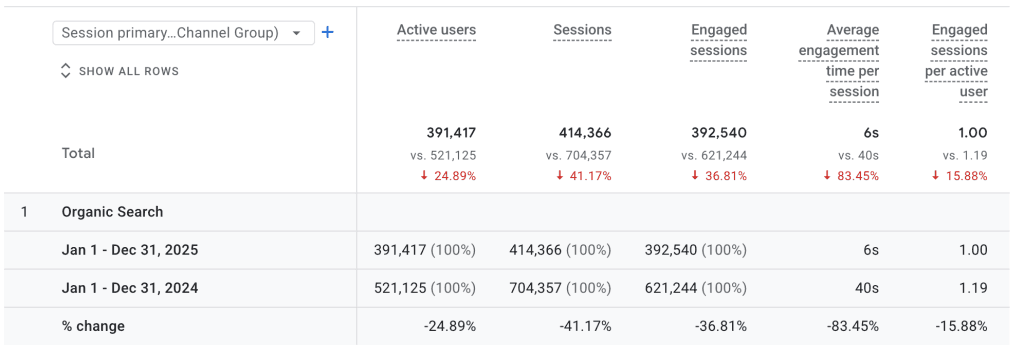
Google Analytics is crucial not just for SEO, but for all digital marketing campaigns tied to your website. At a bird’s-eye view, some of the most important metrics to pay attention to as you track your traffic in Google Analytics 4 (GA4) include:
Sessions: Sessions begin when a user arrives at your site and triggers a session_start event. Unlike older versions, a session won’t artificially reset at midnight or if a user returns via a different marketing campaign, making traffic counts much more accurate.
Active Users: GA4 shifts the focus from total users to active users. This tells you exactly how many unique individuals have come to your site and actually interacted with it, filtering out accidental or empty clicks.
Channels: This will tell you the specific traffic sources bringing in users (organic search, direct traffic, paid ads, organic social, email, etc.), allowing you to see which marketing campaigns are driving the most value.
Audience (Tech & Demographics): You can find clues about who is visiting your site, including their location, interests, age, gender and preferred devices. Modern privacy laws mean GA4 relies heavily on machine learning to fill in these gaps.
Key Events: Formerly known as goals or conversions, you can specify your most valuable user actions (like form submissions, downloads or purchases) as “Key Events” to track how well your site drives business results.
Engagement Metrics: Instead of the old, punishing bounce rate, look at Engagement Rate and Average Engagement Time. These tell you the percentage of sessions that lasted longer than 10 seconds, viewed multiple pages or triggered a key event and how long your site was actually the active, focused tab on their screen.
As a general rule, always keep an eye on year-over-year progress. This is important for understanding variables — for instance, recognizing that a traffic drop in Q4 is just the result of the holiday season. Google Analytics makes it relatively easy to conduct comparisons of YoY traffic and see how specific SEO efforts impact your goals.
Google Search Console
Search Console is even more directly tied to organic search than Google Analytics. It shows you the indexing status of your webpages while elaborating on the performance of those pages across Google Search, Discover and AI-driven search results.
Some of the key metrics to pay attention to on Search Console include:
Impressions: The number of times one of your pages displays in search engine results (including traditional listings and newer features like AI Overviews).
Clicks: The number of times someone clicks on one of your pages listed in the search results.
CTR: The percentage of impressions that resulted in a click.
Average position: The average ranking of your site and its pages in search results.
You can also look at the specific queries that your site is ranking for to see exactly which keywords are generating the most impressions and clicks.
In the standard dashboard, your ability to do long-term year-over-year comparisons is naturally capped because Google Search Console only shows you data from as far back as 16 months. However, it is still incredibly useful to compare shorter timeframes (e.g., the last 45-day period against the prior 45-day period) to catch sudden drops or spikes.
Pro-Tip: If you want to bypass the 16-month limit for permanent YoY tracking, you can plug your Search Console into Google BigQuery to automatically export and save your data forever.
Also keep in mind that “traffic” technically isn’t a Search Console metric. That said, “clicks” will tell you how often users are selecting your webpages from search results, and that remains the ultimate indicator of search-based traffic.
2. Email Marketing
On average, email marketing returns $42 for every $1 spent, according to Litmus.That’s the highest ROI of any digital marketing channel, outpacing paid search ($2), social advertising ($2.80) and display ads ($1.35).
When executed correctly, an engaged email list becomes a priceless traffic source — you’re sending tailored messages to people who already know your brand and have given permission to be contacted.
How To Use It
Technically, email marketing isn’t free, as one of the first things you’ll need is a subscription to an email automation platform such as Marketo, Mailchimp or Salesforce Marketing Cloud Account Engagement. (Strictly speaking, all marketing costs money. However, email and the other channels on this list are not paid traffic sources — you’re paying for the time, energy and tools that help you generate organic traffic, not the actual traffic.)
Email automation makes it much easier to segment your email database into manageable lists based on contacts’ attributes such as location, job title, etc. It also helps you create, schedule and send emails to your lists.
As for the “how” of email marketing, there are a few steps involved if you’re trying to do it at scale. Let’s review the main ones:
Build your email database. You can do this by paying for pre-built email databases, but we recommend building your own database by capturing email addresses organically — for instance, featuring a “subscribe” button on your website or blog, or setting up a scroll-activated pop-up box. Just remember that you need to have some incentive to get them to sign up (great content, discounts, etc.).
Segment your audience. Focus on attributes that are most important to your brand. That could be location, job title, age, gender, customer vs. potential customer or some combination thereof. A well-segmented email list helps deliver the right marketing email to the right person at the right time.
Create an email newsletter. We’re huge fans of the newsletter. It’s a non-salesy way to share useful content and information with subscribers. It’s also a great way to support your organic SEO efforts, specifically by distributing and promoting your content for SEO and driving traffic to those pages.
Maintain your email database. Over time, some of your contacts will leave their current company, or perhaps change their email address. To maximize deliverability and avoid sending emails to inactive addresses, make sure you’re maintaining your database on a regular basis.
Launch other email marketing campaigns. Drip campaigns, lead-nurture emails, onboarding emails — all of them have a place in your email marketing strategy. In addition to driving traffic to your site, they can help move leads deeper into the sales funnel.
How To Track Success in Email Marketing
Outside of the obvious wins — people responding to set up a meeting with sales — you must methodically monitor your incremental gains. At a minimum:
Create custom URLs to track traffic generated from email in Google Analytics. You can do that using Google’s Campaign URL Builder.
Pay attention to metrics such as deliverability, open rate, click-to-open rate, CTR and conversion rate. These should all be trackable through your email marketing automation platform.
If you’re chiefly concerned with traffic to your site, then it’s crucial to create the aforementioned custom URLs.
Otherwise, keep an eye on your email engagement metrics, as these will help you figure out the types of subject lines and content that recipients are most likely to open and engage with.
3. Social Media
When it comes to website traffic sources, the likes of Facebook, X, LinkedIn and other social media channels can’t contend with organic search in terms of volume. Still, they’re essential for brand visibility and engagement.
This is likely because most engagements on social media happen without ever leaving the platform. Users often scroll through their feed, glancing at comments, images, watching videos on mute and occasionally liking something they see or leaving comments.
Nevertheless, a social media presence is more or less an expectation — both in B2B and B2C companies. Even more importantly, social can and often does have very real brand-awareness, lead-generation and traffic-boosting benefits for your website. With the right social media posts, you can tap into new audiences and drive a surge of social media traffic when it matters most.
How To Use It
Social media is great for increasing traffic and brand awareness. Technically, the two aren’t mutually exclusive. If your social media followers are more engaged with your brand, they’re that much more likely to click on a link that navigates to your website.
With that in mind, let’s look at the main steps involved in driving free targeted traffic through social media:
Create content worth sharing: Before you have a prayer at expanding your audience, you need quality content worth sharing with them. Create blog posts, illustrations, YouTube video clips and infographics that will interest potential followers, and start posting them to your social media channels. Compelling content sharing is the fuel for organic social growth.
Promote your social pages on your site: Make sure you have clear links to your social media pages on your website. This will help funnel some traffic to your social media pages. That may sound counterintuitive, but if you get a casual site visitor following you on social media, you essentially create a consistent line of communication with that person — ergo, they become a lead.
Collaborate with influencers: By “influencers,” we don’t mean Kylie Jenner. We mean the unpaid kind — industry peers, thought leaders and even satisfied customers. Reach out to them through social messaging tools, requesting that they follow you in exchange for mentions on your site or social media channels. Engage with the content they post to help be seen by their audiences. Social behavior begets success on social media.
Promote your blog posts on your accounts: Just as you would distribute your content via email, do the same on social media. This will ensure that members of your audience who may not have subscribed to your newsletter but follow you on social media see your content updates.
How To Track Success in Social Media Marketing
Each social media channel is a little different and therefore may have KPI nuances. But across all channels, there are a few common metrics to pay attention to:
Sessions on Google Analytics: Exactly how much of your site traffic is arriving through social media channels.
Impressions: How many times one of your posts shows up in a user’s feed.
Reach: How many users have seen one of your posts.
Click-through rate: Percent of impressions that led to clicks.
Engagements: Comments, likes, clicks, re-posts, shares, etc.
Cost per lead: The amount of money you spent managing organic social (usually as a function of time and effort) against the number of leads you earn.
With the exception of “sessions on Google Analytics,” you can monitor the above metrics through each channel you post on or through a social posting platform like Sprout Social.
4. Guest Posting
Backlinks are highly valuable from an SEO perspective. And as we already established, SEO is crucial to driving organic search traffic.
One of the ways to earn high-quality backlinks to your site is to submit guest blog posts to websites with a strong Domain Authority. If that site publishes your guest post, Google will interpret any links back to your site as a vote of confidence.
Not to mention, you potentially expose your brand to another publisher’s audience, generating referral traffic that supplements the other growing traffic channels you’re managing.
How To Use It
In a nutshell, seek out respectable industry news sources and blogs and try to get in touch about becoming a contributor. For example, a Brafton expert was a regular guest contributor to Moz. Having his content on their site helped earn us backlinks, but it also got our brand in front of Moz’s audience.
And unlike affiliate marketing — which often involves paying a commission to the publisher who links back to your site — guest posting is a mutually beneficial, non-monetary arrangement. In exchange for brand exposure on someone else’s blog, you give them great content that will support their own content marketing goals. Well-crafted guest posts can be evergreen traffic sources, sending qualified visitors long after publication.
How To Measure Success
This one’s easy: Review your referral traffic in Google Analytics.
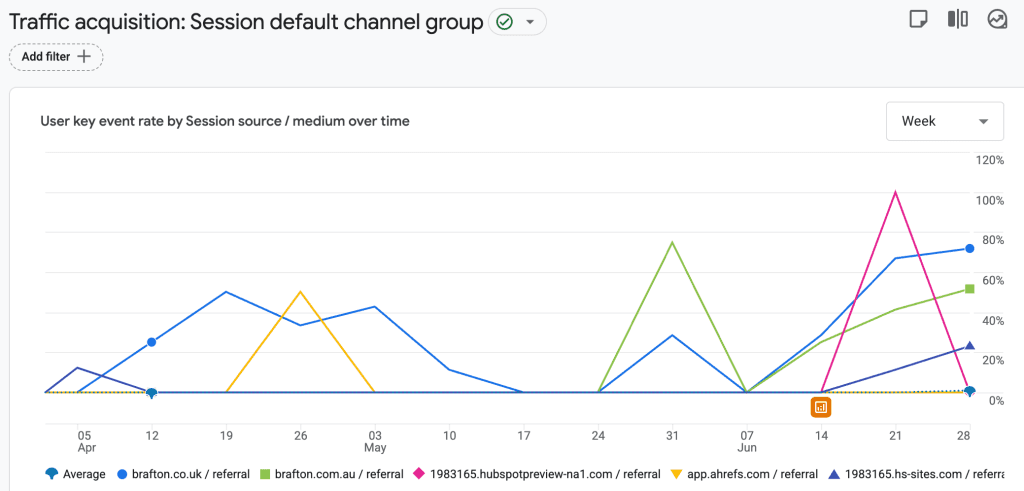
Google Analytics will also show you exactly where those referrals are coming from. Keep this in mind as you think of sites you might want to reach out to about guest posting. If they’re already referring to your domain — and their site has a strong Domain Authority — then by all means, follow that thread.
5. AI Search (AI Overviews & GEO)
AI-powered search results — such as Google’s AI Overviews — are now a major free traffic source. Getting cited in AI Overviews can drive significant visibility and clicks for your brand, often outpacing traditional organic listings.
Generative Engine Optimization (GEO) is the practice of optimizing your content to be included in AI-generated answers and overviews. This means:
Structuring your content to answer questions directly and clearly.
Using schema markup and technical SEO best practices.
Targeting keywords and topics likely to trigger AI Overviews.
According to Seer Interactive, pages cited in AI Overviews earn roughly 120% more clicks per impression than uncited ones. As AI search expands, GEO will become an increasingly important part of any SEO strategy.
How To Measure Success
Monitor your organic traffic and impressions in Google Search Console. If your pages are cited in AI Overviews, you should see spikes in impressions and clicks for relevant queries.
6. YouTube & Video
Video is a powerful free traffic source, with YouTube acting as both a search engine and a referral platform. Optimizing your videos for search — including GEO — can drive substantial traffic to your website.
How To Use It
Create educational or entertaining videos related to your industry, products or services.
Optimize video titles, descriptions, and tags for relevant keywords.
Add links to your website in video descriptions and within the video itself.
Engage with viewers through comments and community posts to build loyalty and encourage content sharing.
YouTube videos can rank in Google search results and even be featured in AI Overviews, amplifying your reach.
How To Measure Success
Track referral traffic from YouTube in Google Analytics and monitor video analytics for impressions, watch time and click-throughs to your website.
7. Reddit, Medium and Industry Forums
There’s more than one way to win backlinks and referral traffic. Reddit, in particular, has become a massive search traffic source as Google now elevates Reddit threads in results far more prominently than in years past.
How To Use Them
Reddit:
Identify relevant subreddits for your industry, product or expertise.
Participate authentically by answering questions, sharing insights and linking to your website only when it genuinely adds value.
Create original posts or comments that solve problems or provide unique perspectives. Avoid blatant self-promotion, as Reddit communities value transparency and authenticity.
Monitor trending topics and join conversations early to maximize visibility.
Medium:
Publish articles on Medium, but note its SEO value has declined compared to Reddit and niche forums.
Use Medium primarily for brand storytelling or thought leadership, linking back to your website when appropriate.
Industry Forums:
Join niche forums and Q&A platforms related to your business.
Answer questions, offer practical tips, and provide links to your site as resources.
Forums can be a consistent source of referral traffic and backlinks.
How To Measure Success
Track referral traffic in Google Analytics. See which forums, subreddits or Medium articles are sending visitors to your site, and focus your efforts on the most effective communities.
Conclusion: Maximize Your Free Traffic Sources
Free website traffic is more abundant — and more diverse — than ever. Organic search, email marketing, social media, guest posting, AI search, YouTube/video and platforms like Reddit and industry forums all offer unique opportunities to drive qualified visitors to your site.
Success depends on harnessing each traffic source effectively and continuously refining your marketing efforts for better performance. Monitor your analytics, experiment with new tactics and stay ahead of search and platform changes — especially as AI and new technologies reshape how people discover content.
Editor’s Note: Updated June 2026.


